How to become senior AI Engineer
- Anastasia Karavdina
- Jul 27, 2025
- 4 min read

5 steps you should do if you're seeking as Data Scientist of ML/AI Engineer.
As companies increasingly rely on data to shape their products, services, and customer experiences, the demand for AI specialists who can bridge the gap between technical insight and business value is at an all-time high. It is no longer enough to simply build accurate models. Organizations need AI engineers who can embed intelligence into systems, translate complex algorithms into real-world impact, and align their work with broader strategic goals. A senior AI expert is expected to thrive across multiple domains: drive strategic decisions, influence business outcomes, and mentor the next wave of talent. They must navigate both the deep technical challenges of production-ready AI and the equally demanding soft skills of communication, stakeholder alignment, and leadership. In short, the role requires a rare mix of builder, translator, and visionary — someone who does not just write code, but boost the business with intelligent products.
But what does it take to grow from an entry-level AI Engineer to a senior, business-facing expert? In this short article, I’d like to share 5 of the most critical steps toward career advancement.
✅ 1. Embrace Full Ownership

Go beyond prototyping. Own the entire AI lifecycle: from problem discovery and data engineering to deployment, MLOps, monitoring, and maintenance. Senior engineers stand out not just for their productivity, but for their ability to lead complex, cross-team projects. Your code should solve problems and stay resilient in production. That means thinking beyond model performance to ensure reliability, scalability, and alignment with real-world constraints. Ownership also includes anticipating failure modes, setting up alerting systems, and collaborating closely with product, data, and engineering teams. When you take full responsibility for the lifecycle of your solutions, you build trust. And that trust is what opens the door to more autonomy, influence, and leadership opportunities.
✅ 2. Deliver End-To-End

Launch production-ready systems, not just notebooks. A senior AI engineer bridges the gap between experimentation and real-world usage by building reliable, maintainable, and scalable systems. This means taking your models beyond the comfort of Jupyter and embedding them into actual infrastructure — through data pipelines, APIs, frontend or backend integrations, and robust monitoring solutions. Production delivery involves version control, CI/CD pipelines, testing frameworks, and thoughtful handling of edge cases. Remember, the biggest impact rarely comes from novel algorithms, but from solid, scalable implementation that actually reaches users and integrates seamlessly into business processes. End-to-end delivery also means taking responsibility for model performance post-deployment and continuously improving based on feedback and drift. If your work never makes it to production, it is just a PoC and not impact.
✅ 3. Start with the Business Problem

Always begin by asking: What decision or user outcome are we enabling? Resist the shiny-toy syndrome. Focus on tools that solve real customer pain points. Anchor your work in business metrics that matter: adoption, retention, saved hours, revenue gains, cost reduction, not just model accuracy.
Always begin by asking: What decision or user outcome are we enabling? As a senior AI engineer, your impact is measured not by how complex your models are, but by how effectively your work solves real problems. Resist the shiny-toy syndrome — the temptation to use the latest model or framework just because it is trending. Instead, focus on understanding the pain points of customers, stakeholders, or internal users. Talk to product managers, support teams, and business leads. Map technical tasks to tangible outcomes.
The value of AI is not in the algorithm itself, but in the action it enables. That’s why it's essential to anchor your work in business metrics that matter: adoption, retention, saved hours, revenue growth, cost reduction, or risk mitigation. A model with 95 percent accuracy that no one uses is less valuable than a simpler one that drives daily decisions. When you frame problems from the perspective of business value, you gain clarity on trade-offs, improve collaboration, and build solutions that actually move the needle.
✅ 4. Build Hybrid Technical and Soft Skills

Master every tool and framework used in your organization. A senior AI engineer is expected to navigate the entire stack — from data infrastructure and orchestration tools to model deployment frameworks and monitoring dashboards. You should be the person others turn to when they’re stuck on Spark performance, debugging a DAG, or choosing the right embedding strategy for a retrieval pipeline. Technical fluency earns you respect — but it’s only half the story.
To truly lead, you must pair your technical expertise with strong soft skills. Emotional intelligence, stakeholder management, and clear communication are just as critical at senior levels as any ML technique. It’s not enough to build the right solution — you need to explain why it matters, how it works, and what the trade-offs are. You’ll often need to translate between technical constraints and business priorities, especially when timelines are tight or requirements are vague.
✅ 5. Demonstrate Tangible Outcomes
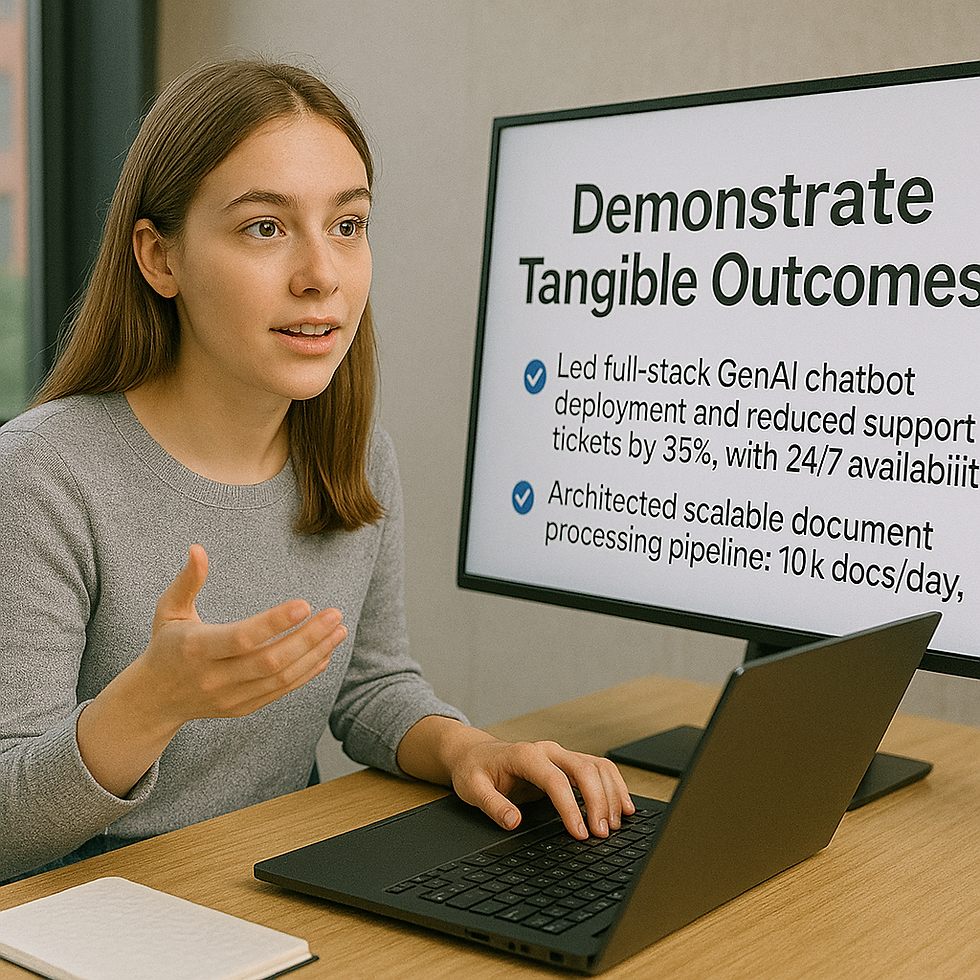
Make your impact obvious. Highlight it in your résumé, reviews, and team updates.
For example:
• Led full-stack GenAI chatbot deployment and reduced support tickets by 35%
• Architected scalable document processing pipeline handling 10k docs/day with 99.7% uptime
Stepping into a senior AI role isn’t about waiting for permission. It’s about actively expanding your scope, owning outcomes, and consistently aligning your work with real business needs. The journey requires patience, curiosity, and intentional practice, but it also brings the reward of greater influence, autonomy, and impact. If you invest in the right habits now, you won’t just grow into a senior title, you’ll earn the trust that comes with it.
Whether you're presenting to stakeholders, leading cross-functional initiatives, or mentoring the next generation, your growth as an AI Engineer is as much about leadership and clarity as it is about models and math.
Focus on solving real problems, and the senior title will follow.
Reach out via contact form, if you feel stuck and looking for a roadmap and support to reach the next level!
Comments